05Mar

Financial Analysis Translation Services in UAE – AW PTS

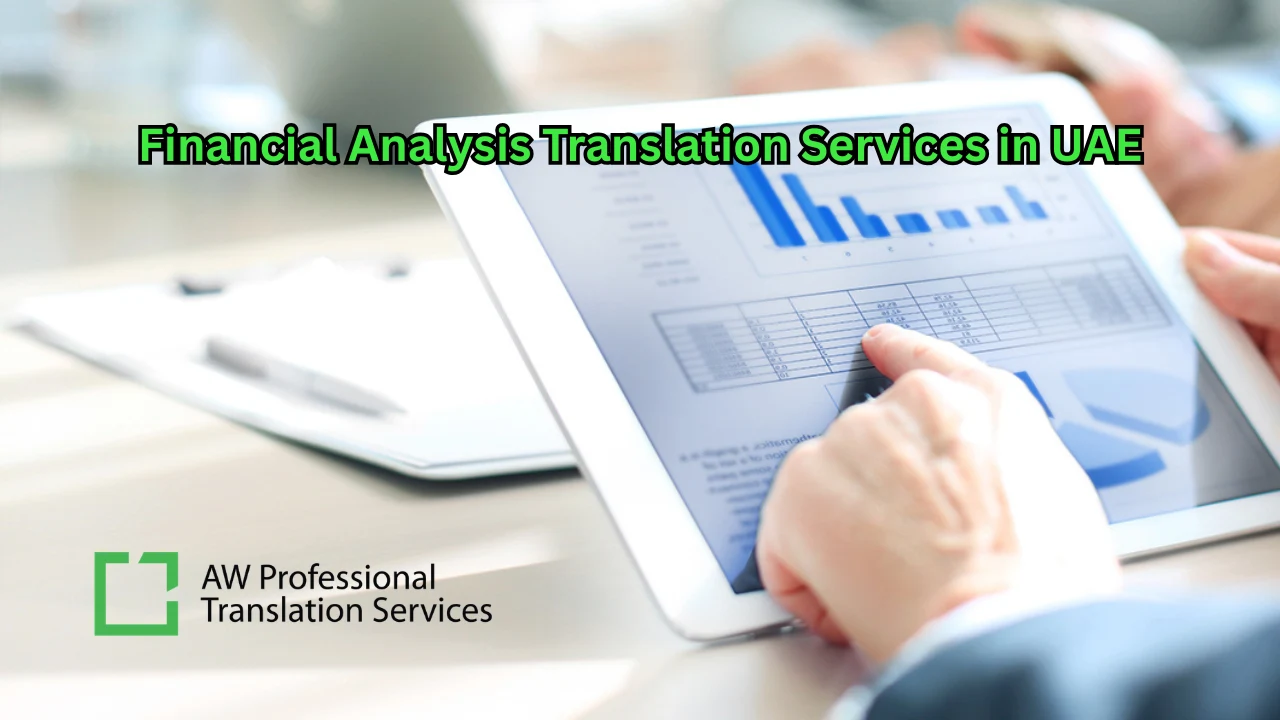
In today’s global business environment, financial information often needs to cross language and border barriers. Accurate translation of financial documents is crucial for making informed decisions, securing investments, and ensuring regulatory compliance. Professional Financial Analysis translation helps businesses, investors, and regulatory bodies in the UAE understand complex financial data accurately and confidently.

At AW PTS, we provide expert translation services for financial analyses, reports, and statements, ensuring accuracy, confidentiality, and compliance with local and international standards.

What Is Financial Analysis?

What Is Financial Analysis?

Financial analysis is the systematic evaluation of a company’s financial performance, health, and future outlook. It involves reviewing financial statements, ratios, and reports to make informed business or investment decisions.

Financial analysis typically includes:

  • Balance sheets and income statements

  • Cash flow statements

  • Profitability and liquidity ratios

  • Budget reports and forecasts

  • Investment appraisals and valuations

  • Risk and performance metrics

Because these documents contain technical financial terminology and numerical data, precise translation is essential to avoid misinterpretation.

Learn about E-learning Localization

Why Financial Analysis Translation Is Important

Accurate Financial Analysis translation is vital for businesses operating in international markets or engaging with foreign stakeholders. Key benefits include:

  • Informed Investment Decisions: Investors can accurately assess opportunities and risks.

  • Regulatory Compliance: Multinational companies can submit reports to UAE authorities or foreign regulators in the required language.

  • International Business Expansion: Accurate translations facilitate mergers, acquisitions, partnerships, and cross-border operations.

  • Risk Management: Avoids errors caused by misinterpretation of financial metrics.

  • Stakeholder Communication: Builds trust with investors, management teams, and clients by providing clear financial information.
contact us aw pts

Common Documents Requiring Financial Analysis Translation

Our services cover a wide range of financial documents, including:

1. Annual and Quarterly Reports

Comprehensive financial summaries for investors, management, and regulatory authorities.

2. Audit Reports

Internal and external audit documentation requiring precise translation to reflect financial compliance accurately.

3. Investment Appraisals and Valuations

Documents assessing business or project value, profitability, and potential risks.

4. Financial Forecasts and Budgets

Future-oriented financial plans that guide strategic decisions and require accuracy in terminology and numbers.

5. Risk Assessments and Performance Metrics

Reports analyzing financial risks, operational efficiency, and profitability ratios.

Our Financial Analysis Translation Process
Our Financial Analysis Translation Process

At AW PTS, we follow a professional process to ensure accuracy, confidentiality, and compliance:

  1. Secure Document Submission – Clients upload documents through encrypted systems.

  2. Document Assessment – We determine industry specialization, language pair, and certification requirements.

  3. Expert Translation – Translators with financial expertise accurately convert terminology, figures, and formatting.

  4. Quality Assurance – A second reviewer checks for accuracy, consistency, and compliance.

  5. Certification (if required) – Documents are certified for official or legal use.

  6. Secure Delivery – Final translations are delivered safely and on time.

Learn Data-driven localization strategy

Why Choose AW PTS for Financial Analysis Translation?

By partnering with AW PTS, businesses in the UAE gain:

  • Expert translators specialized in finance and accounting

  • Certified translations recognized by authorities and stakeholders

  • Strict confidentiality and secure handling of sensitive financial data

  • Fast turnaround for time-sensitive reports

  • Assurance of numerical accuracy and consistent terminology

contact us aw pts

FAQS

1. What is Financial Analysis translation?

Financial Analysis translation involves accurately converting financial documents such as balance sheets, income statements, audits, and forecasts into another language while preserving numerical accuracy and technical terminology.

2. Why is Financial Analysis translation important in the UAE?

In the UAE, businesses, investors, and regulators often require financial documents in multiple languages. Accurate translation ensures informed decision-making, regulatory compliance, and clear communication with stakeholders.

3. Which financial documents require translation?

Common documents include:

  • Annual and quarterly reports

  • Audit reports

  • Investment appraisals and valuations

  • Financial forecasts and budgets

  • Risk assessments and performance metrics

4. How does AW PTS ensure accuracy in Financial Analysis translation?

AW PTS uses specialized financial translators, a multi-step quality assurance process, and optional certified translation. Every document is reviewed for numerical accuracy, terminology consistency, and regulatory compliance.

5. Are Financial Analysis translations confidential?

Yes. AW PTS follows strict confidentiality protocols and secure document handling, ensuring sensitive financial data remains protected throughout the translation process.

6. Can translated financial reports be used for official or regulatory purposes?

Absolutely. AW PTS provides certified translations when required, which are accepted by UAE authorities, auditors, investors, and international partners.


Conclusion

Accurate Financial Analysis translation is essential for decision-making, regulatory compliance, and international business success. With professional services from AW PTS, companies can confidently share financial insights, communicate with global stakeholders, and make informed strategic decisions in the UAE and beyond.

Follow us on Linkedin for more info 
02Mar

Telecommunication Translation Services in UAE

The telecommunications industry is rapidly evolving, with companies in the UAE and across the globe offering advanced technologies, digital services, and international connectivity. Clear and accurate communication is essential for this highly technical sector, making Telecommunication Translation Services in UAE a crucial resource for businesses looking to expand, comply with regulations, and communicate effectively with international clients and partners.

At AW PTS, we specialize in professional telecommunication translation services that ensure your technical documents, manuals, and marketing content are precisely translated and culturally adapted for your target audience.

What Are Telecommunication Translation Services?

What Are Telecommunication Translation Services?

Telecommunication Translation Services involve converting technical and business content related to the telecom sector from one language to another while maintaining accuracy, clarity, and technical correctness. These services are critical because telecom documents often contain highly specialized terminology, legal clauses, and regulatory references.

Common documents requiring translation include:

  • Technical manuals and user guides

  • Software and application interfaces

  • Regulatory and compliance documents

  • Contracts and service agreements

  • Marketing brochures and product specifications

  • Training materials for staff and partners

Professional translation ensures that these materials are not only linguistically accurate but also compliant with local regulations in the UAE and other target markets.

 Learn how we manage Quality assurance in localization

Why Telecommunication Translation Services Are Important

The UAE telecom industry is highly regulated, with companies needing to comply with local standards, licensing requirements, and international protocols. Errors or misinterpretations in technical translations can lead to:

  • Regulatory non-compliance

  • Operational inefficiencies

  • Miscommunication with customers or partners

  • Delays in product launches or service delivery

  • Legal disputes

By using expert Telecommunication Translation Services in UAE, companies can safeguard their operations, improve customer experience, and expand confidently in international markets.

contact us aw pts

Key Features of Professional Telecommunication Translation Services

At AW PTS, we provide specialized translation solutions tailored to the telecom industry. Our services include:

1. Technical Accuracy

We ensure precise translation of telecom terminology, network specifications, software interfaces, and technical manuals.

2. Regulatory Compliance

Our team is familiar with UAE telecommunication laws and international standards, ensuring that all translated documents meet legal requirements.

3. Multilingual Capabilities

We provide translations in multiple languages, enabling telecom companies to serve diverse clients across the Middle East and beyond.

4. Cultural Adaptation

Our translations are culturally sensitive, making content understandable and relevant for local audiences.

5. Confidentiality and Security

We handle sensitive corporate and technical information with the highest level of confidentiality, ensuring data protection at every stage.

Learn about E-learning Localization

Industries and Clients That Benefit from Telecommunication Translation

Industries and Clients That Benefit from Telecommunication Translation

Telecommunication Translation Services are essential for:

  • Mobile network operators

  • Internet service providers

  • Satellite communication companies

  • IT and networking companies

  • Telecom equipment manufacturers

  • International partners and vendors

Any organization operating in the telecom sector, whether providing services, technology, or hardware, benefits from precise and reliable translation.

Advantages of Partnering with AW PTS

By choosing AW PTS for Telecommunication Translation Services in UAE, businesses gain:

  • Access to translators with telecom expertise

  • Accurate, certified translations for legal and technical use

  • Fast turnaround to meet operational deadlines

  • Seamless localization for marketing and user-facing materials

  • Assurance of regulatory compliance in the UAE and other markets

Our goal is to help telecom companies communicate clearly, maintain compliance, and expand their operations smoothly.

contact us aw pts

FAQS

1. What are Telecommunication Translation Services?

Telecommunication Translation Services convert technical and business content related to the telecom industry from one language to another, ensuring accuracy, clarity, technical correctness, and compliance with local regulations.

2. Why are Telecommunication Translation Services important in the UAE?

The UAE telecom sector is highly regulated. Professional translation ensures:

  • Compliance with local laws and licensing requirements

  • Accurate communication with international clients and partners

  • Avoidance of operational errors, delays, or legal disputes

  • Smooth product launches and service delivery

3. What types of documents require telecommunication translation?

Common documents include:

  • Technical manuals and user guides

  • Software and application interfaces

  • Regulatory and compliance documents

  • Contracts and service agreements

  • Marketing brochures and product specifications

  • Training materials

4. What are the key features of professional telecommunication translation?

Key features include:

  • Technical accuracy and correct telecom terminology

  • Compliance with UAE and international regulations

  • Multilingual translations for diverse markets

  • Cultural adaptation for target audiences

  • Confidentiality and data security

5. Which industries benefit from telecommunication translation?

Industries include:

  • Mobile network operators

  • Internet service providers

  • Satellite communication companies

  • IT and networking firms

  • Telecom equipment manufacturers

  • International telecom partners and vendors

Conclusion

The telecommunications sector thrives on precision, reliability, and connectivity. Accurate Telecommunication Translation Services in UAE ensure that your technical documents, contracts, and marketing materials are fully understandable and compliant, both locally and internationally.

With AW PTS, businesses in the UAE can confidently reach global audiences, maintain regulatory compliance, and enhance operational efficiency through expert telecommunication translations.

Follow us on Linkedin for more info 

01Mar

How much can artificial intelligence really change the way we localize content? Are large language models the end of traditional workflows, or just another tool in the toolbox?

In the past few years, we’ve seen massive leaps in natural language processing, and large language models (LLMs) like ChatGPT, Claude, and others are at the heart of it. These tools are not just influencing the way we write and translate, they’re reshaping entire localization workflows. From content preparation to post-editing, the AI touch is everywhere.

But while LLMs can be powerful allies, they’re not without their flaws. Let’s dig into how these models are changing localization processes, where they truly shine, and where they still need a human touch.

What Are Large Language Models, Really?

What Are Large Language Models, Really?

Before we dive into their impact, let’s get on the same page.

Large language models are AI systems trained on huge amounts of text data. They learn patterns, syntax, grammar, and even context by processing billions of words. That’s how they’re able to generate coherent content, translate text, or summarize documents in multiple languages.

They’re not rule-based like traditional machine translation tools. Instead, they generate language probabilistically, meaning they predict what’s likely to come next in a sentence based on the input they receive.

The result? Fast, relatively accurate language generation. But does that mean they’re ready to take over localization? Not quite.

 Learn how we manage Quality assurance in localization

Where LLMs Shine in Localization Workflows

  1. Pre-Translation Preparation

One of the most time-consuming stages in localization is prepping content, cleaning up the source text, identifying strings, standardizing terminology, and removing inconsistencies. LLMs can assist in automating these prep steps with surprising efficiency.

Use case: An LLM can scan a batch of marketing content, flag inconsistencies in brand voice, and even suggest improvements before it reaches the translator’s desk. It can also detect placeholder errors, non-translatable elements, or formatting that could break in localized versions.

This speeds up the process and reduces the likelihood of errors making it into the final translation.

  1. Draft Translation Generation

LLMs can generate first-pass translations in a wide range of languages. While they’re not perfect, they offer a strong starting point for human post-editors.

Why it works: Unlike older machine translation engines that can feel robotic, LLMs often produce more natural, fluid language. This makes them especially useful for marketing, customer support, or user interface content, areas where tone matters.

Important note: Even when using LLMs for draft translations, human review is non-negotiable. The AI doesn’t always understand tone, idioms, or brand-specific nuances.

  1. Multilingual Terminology Suggestions

When consistency is key, LLMs can be fed a glossary or termbase and asked to expand, clean, or even localize it into different languages. They can suggest synonyms, check for regional variations, and even explain why a term may or may not fit a certain locale.

This saves valuable time for terminologists and QA specialists, especially when launching new products in multiple markets at once.

contact us aw pts

Where LLMs Still Fall Short

Let’s be honest, the hype around LLMs often glosses over some critical limitations, especially in localization.

  1. Cultural Understanding Is Still Surface-Level

LLMs are trained on massive datasets, but they don’t understand culture the way humans do. They might translate the words correctly but still miss the tone, symbolism, or emotion behind them.

Example: A slogan that works in the U.S. might be awkward or even offensive in the Middle East or Japan. A human translator would catch that. An LLM might not.

Cultural context is about more than language, it’s about sensitivity, awareness, and adaptation. That’s still very much a human skill.

  1. Inconsistent Quality Across Languages

LLMs tend to perform better in English and a few high-resource languages. But if you’re localizing into Amharic, Pashto, or other underrepresented languages, the results can be wildly inconsistent.

For companies operating in emerging markets or multilingual regions, this is a serious drawback. You still need professional translators who understand local grammar, idioms, and tone.

  1. Hallucinations and Mistranslations

This is the big one. LLMs are known to “hallucinate” which means they can generate information that sounds correct but is factually wrong.

In localization, this is a risk. If you’re localizing legal documents, medical instructions, or compliance text, even a small error can lead to serious consequences.

That’s why critical content must always pass through human eyes, no matter how advanced the AI is.

Learn about E-learning Localization

AI Localization Trends: What’s Next?

The rise of LLMs is pushing the localization industry into new territory. And while there are growing pains, there are also some exciting trends worth watching.

  1. Post-Editing Becomes the Norm

Instead of full human translation, more teams are shifting toward a post-editing model, where LLMs handle the first draft, and professional linguists refine it.

This can reduce turnaround times and costs, but only if the right quality checks are in place.

  1. Custom-Trained AI Models for Specific Brands

Some companies are now training LLMs on their internal content, style guides, past translations, brand guidelines, to create a more “on-brand” translation engine.

This hybrid model bridges the gap between generic AI and specialized human work. It’s one of the more promising developments in large language models localization.

  1. Human-AI Collaboration Platforms

Rather than replacing translators, the smartest tools are building platforms that allow AI and linguists to work side-by-side.

Features like AI-generated suggestions, real-time terminology prompts, or AI-assisted QA checks are becoming part of the everyday CAT tool experience.

The goal isn’t to eliminate the human touch, it’s to amplify it.

Learn : Why you should hire a court interpreter 

Final Thoughts

Large language models are not here to take your job, but they are changing the way localization is done. They streamline workflows, speed up processes, and reduce repetitive tasks. But they also come with real limitations, especially when it comes to cultural nuance, language diversity, and context accuracy.

So what does this mean for your localization strategy?

Use AI where it makes sense, but don’t let it be the final decision-maker. The best results still come from a smart blend of technology and human insight.

Also learn : VR Localization

Because at the end of the day, localization isn’t just about words, it’s about people.

Follow us on Linkedin for more info 

26Feb

The Role of AI in Localization: Benefits and Limitations in 2026

We all know AI has its limits, but does that really apply to translation too? I mean, translation sounds like the perfect job for AI, right? It’s based on words, grammar, and dictionaries, basically, data, and that’s where AI is supposed to excel. So how can it possibly fall short?

Well, here’s the thing: translation isn’t just about swapping words based on dictionary definitions. It’s about understanding context, tone, culture, and meaning, and that’s where things get tricky for AI. Let me show you what I mean with a quick example. Let’s say you have an English marketing slogan like:

“Kick off your summer with sizzling deals!”

A literal AI translation into another language (like Japanese or Arabic) might try to directly translate “kick off” and “sizzling deals” word for word.

But here’s the issue:

  • “Kick off” as an idiom might be translated literally as physically kicking something, which could sound confusing or aggressive in another language.
  • “Sizzling deals” might be turned into something about actual heat or cooking, instead of implying exciting discounts.

A native speaker or human translator would understand the meaning behind the phrase, it’s about starting summer with excitement and great discounts, and they’d come up with a local expression that delivers the same emotion and intent, even if the words are different.
That was just a quick example of how AI can have some limitations in this field, but now let’s dive deep into this topic, explaining how to benefit from AI and when not to depend on it.

How AI Enhances Localization

How AI Enhances Localization

AI is a shining star in efficiency and cutting time short; instead of taking all day working on one project, AI can make it in just a couple of minutes. here are some points that will explain it more to you.

  1. Fast and Accurate Machine Translation
    AI-powered translation tools can handle huge volumes of content in a short amount of time. They use advanced language models that learn from millions of examples, which helps improve their accuracy over time. For companies with ongoing content updates, this speed is a big win.
  2. Consistency Across All Content
    One of AI’s strengths is keeping things consistent. If your brand uses specific terms or phrases, AI tools can make sure they appear the same way every time across different languages. This is especially helpful for technical content or brands with strict language guidelines.
  3. Seamless Automation
    AI tools can connect directly to your content systems, like your website, app, or internal platforms. This means you can update content in one place, and the AI will help localize it automatically without needing to send files back and forth. It saves time and reduces mistakes.
  4. Smart Content Management
    With AI, you get access to useful insights about how your localized content is performing. It can show you which markets are engaging more and where users might be dropping off. These analytics help you fine-tune your message for each region.
  5. Support for Editors and Translators
    AI doesn’t replace human translators, it supports them. AI can pre-edit content to make it easier to translate and then help with suggestions during the review process. This allows human linguists to focus on cultural tone, style, and emotional impact instead of repetitive edits.

 Learn how we manage Quality assurance in localization

Now we know how we can benefit from AI, right? But AI is not that perfect, let me tell you why

contact us aw pts

Limitations of AI in Localization


AI is a powerful tool, but when it comes to localization, it still has some real gaps. Here’s where things can fall short:

  1. Missing the Cultural Context
    AI might know the language, but it doesn’t really understand culture. It can easily miss the meaning behind jokes, idioms, slang, or references that are tied to a specific place or group of people. This can lead to awkward, confusing, or even offensive translations that just don’t land with the local audience.
  2. Struggles with Emotion and Tone
    Human language is full of nuance. A sarcastic comment, a friendly tone, or a heartfelt message can all be lost on AI. It’s good at literal meaning but not great at picking up on feelings. For content that relies on emotion, like marketing campaigns, brand messages, or storytelling, AI often misses the mark.
  3. Trouble with Creative Language
    If you’re localizing something creative, like a movie script, video game dialogue, or a clever ad slogan, AI tends to fall flat. It usually doesn’t “get” wordplay, puns, or double meanings. These are areas where a human touch is absolutely necessary to preserve the creativity in another language.
  4. Not Always Reliable for Niche Topics
    When working with industry-specific content, like legal, medical, or technical documents, AI can struggle unless it has been trained on that exact kind of language. Even then, a small mistake in these fields can have serious consequences, so human review is a must.
  5. Lacks Accountability
    AI can’t be held responsible for its choices. If something goes wrong or a message is misunderstood, you can’t ask the AI to explain itself. This is why human oversight is crucial. Someone has to be accountable for ensuring the final message is accurate and appropriate.
  6. Risk of Bias and Errors
    AI models are trained on large datasets from the internet, and that data sometimes includes biased or outdated language. If you’re not careful, those biases can creep into your translations, which could hurt your brand or alienate your audience.

Now you are asking, so should I use AI or not am a little bit confused.
Let’s discuss this briefly.

Learn about E-learning Localization

When to use AI in localization and when not

When to use AI in localization and when not

Use It When:

  • There is a large volume of simple content like product descriptions, manuals, or internal documents.
  • If you need consistency across multiple pages, files, etc.
  • If you want to create first drafts that human translators can polish.
  • When you need fast turnaround across multiple languages.


Don’t Use It When:

  • When you need creative or emotional content like ads, slogans, or stories.
  • If you are working with culturally sensitive material, where tone and context matter.
  • I don’t need to mention it, but don’t depend on it with legal, medical, or safety-critical documents where accuracy is vital.
  • Shouldn’t be used when your brand’s voice or reputation is on the line.
  • Learn : Why you should hire a court interpreter 

Follow us on Linkedin for more info 

25Feb

Annual Reports Translation & Localization Guide | AW PTS

In today’s globalized business environment, annual reports are no longer limited to a single market or language. Companies with international investors, stakeholders, regulators, and partners must ensure that their annual reports are accurately translated and culturally localized. This is where a professional Annual Reports Translation & Localization Guide becomes essential.

Annual reports are among the most sensitive and high-impact corporate documents. They combine financial data, strategic narratives, legal disclosures, and brand messaging. A single mistranslation can damage credibility, mislead stakeholders, or even create regulatory risk. This guide explains what annual report translation and localization involve, the types of annual reports, why localization is critical, and how AW PTS delivers reliable, compliant, and high-quality solutions.

What Is Annual Reports Translation and Localization?

What Is Annual Reports Translation and Localization?Annual reports translation is the process of converting an organization’s annual report from one language into another while preserving accuracy, clarity, and intent. However, localization goes beyond linguistic translation.

Annual reports localization adapts the content to meet:

  • Local financial terminology

  • Regulatory and legal expectations

  • Cultural and business communication norms

  • Formatting and numerical conventions

In other words, translation ensures the report is readable, while localization ensures it is understood, accepted, and trusted by the target audience.

This distinction is central to any effective Annual Reports Translation & Localization Guide.

 Learn how we manage Quality assurance in localization

Why Annual Reports Are Critical Business Documents

Annual reports are not simple summaries. They are strategic communication tools that serve multiple purposes:

  • Informing shareholders and investors

  • Demonstrating transparency and governance

  • Meeting regulatory and compliance obligations

  • Communicating corporate strategy and performance

  • Building trust with global stakeholders

Because of their importance, annual reports must maintain absolute accuracy across all languages and regions.

contact us aw pts

Types of Annual Reports

Understanding the different types of annual reports is essential before discussing translation and localization.

1. Corporate Annual Reports

These are the most common and comprehensive reports issued by companies. They typically include:

  • Chairman’s and CEO’s messages

  • Company overview and strategy

  • Financial statements

  • Risk disclosures

  • Corporate governance information

Corporate annual reports are often distributed to international investors, making professional localization essential.

Learn about E-learning Localization

2. Financial Annual Reports

Financial annual reports focus primarily on financial performance and compliance. They include:

  • Balance sheets

  • Income statements

  • Cash flow statements

  • Auditor reports

  • Notes to financial statements

These reports require translators with strong financial and accounting expertise. Errors in figures, terminology, or disclosures can have serious legal consequences.

3. Integrated Annual Reports

Integrated reports combine financial performance with non-financial information such as sustainability, ESG (Environmental, Social, Governance), and long-term value creation.

Localization here is especially important because ESG terminology, reporting standards, and expectations vary by region.

4. Public Sector and Government Annual Reports

Government entities and public institutions publish annual reports to demonstrate accountability and transparency. These reports often need to be localized for international organizations, donors, and regulatory bodies.

Accuracy, neutrality, and formal tone are critical.

5. Non-Profit and NGO Annual Reports

NGOs and non-profit organizations use annual reports to communicate impact, funding allocation, and mission progress to international donors and partners.

Localization must reflect cultural sensitivity, clarity, and alignment with donor expectations.

Learn : Why you should hire a court interpreter 

Why Annual Reports Translation & Localization Is Necessary

Why Annual Reports Translation & Localization Is NecessaryMany organizations underestimate the complexity of annual reports translation. However, localization is not optional, it is essential.

1. Regulatory and Legal Compliance

Different countries have strict rules governing financial disclosures and corporate reporting. A localized annual report ensures compliance with:

  • Local financial terminology

  • Regulatory language requirements

  • Disclosure standards

Poor translation can result in regulatory scrutiny or rejection.

Also learn : VR Localization

2. Investor Confidence and Trust

International investors rely on localized annual reports to make informed decisions. Inaccurate or unclear translations can reduce confidence and harm credibility.

A professional Annual Reports Translation & Localization Guide ensures that strategic messaging and financial performance are communicated clearly.

3. Financial Accuracy and Risk Reduction

Annual reports contain sensitive financial data. Localization ensures:

  • Correct numerical formats

  • Accurate financial terminology

  • Clear explanations of risk and performance

This minimizes the risk of misinterpretation.

4. Brand Consistency Across Markets

Annual reports reflect a company’s brand voice and leadership vision. Localization ensures that tone, messaging, and values remain consistent across languages.

5. Global Stakeholder Communication

Employees, partners, regulators, investors, and media across different regions all rely on annual reports. Localization ensures that each audience receives information in a clear and culturally appropriate way.

The Annual Reports Translation & Localization Process

Professional annual report localization follows a structured workflow to ensure quality and compliance.

1. Content Assessment and Planning

The process begins with a detailed review of the report to identify:

  • Document scope and complexity

  • Target languages and regions

  • Financial, legal, and ESG components

  • Formatting and design requirements

This planning phase is critical for efficiency and accuracy.

2. Specialized Translation by Expert Linguists

Annual reports require linguists with expertise in:

  • Finance and accounting

  • Corporate governance

  • Legal disclosures

  • Investor communications

At AW PTS, only subject-matter specialists handle annual report translation.

3. Localization of Financial and Regulatory Content

Localization ensures alignment with:

  • Local accounting terminology

  • Regulatory language conventions

  • Market-specific reporting expectations

This step ensures the report is compliant and credible in each target market.

4. Formatting and Layout Adaptation

Annual reports often contain tables, charts, and complex layouts. Localization includes:

  • Adapting text expansion or contraction

  • Maintaining visual consistency

  • Ensuring correct numerical and date formats

This preserves the professional appearance of the report.

5. Quality Assurance and Review

A multi-level review process ensures:

  • Linguistic accuracy

  • Financial consistency

  • Terminology alignment

  • Compliance with client and regulatory standards

Quality assurance is non-negotiable for annual reports.

Common Challenges in Annual Reports Localization

Common Challenges in Annual Reports LocalizationWithout professional support, organizations often face:

  • Incorrect financial terminology

  • Inconsistent translations across sections

  • Cultural misalignment in leadership messaging

  • Formatting errors in tables and figures

  • Compliance risks

A structured Annual Reports Translation & Localization Guide helps avoid these issues.

Why Machine Translation Is Not Enough for Annual Reports

While machine translation can be useful for internal drafts, it is not suitable for final annual reports.

Machine translation often fails to:

  • Understand financial and legal nuance

  • Maintain consistent terminology

  • Ensure regulatory compliance

  • Provide accountability

Annual reports require human expertise, review, and responsibility.

Why Choose AW PTS for Annual Reports Translation & Localization?

AW PTS provides professional annual reports translation and localization services designed for global organizations.

With AW PTS, you benefit from:

  • Financial and legal subject-matter experts

  • Consistent terminology management

  • Multilingual quality assurance

  • Secure and confidential handling

  • Scalable solutions for global reporting

AW PTS understands that annual reports are not just documents, they are strategic assets.

contact us aw pts

Industries That Rely on Annual Reports Localization

Annual reports localization is essential across industries, including:

  • Financial services and banking

  • Public companies and listed entities

  • Technology and SaaS firms

  • Energy and manufacturing

  • Government and public sector

  • NGOs and international organizations

Each sector requires precision, compliance, and professionalism.


Final Thoughts

This Annual Reports Translation & Localization Guide highlights why professional localization is essential for global transparency, compliance, and credibility. Annual reports communicate performance, strategy, and trust, and errors can be costly.

By partnering with AW PTS, organizations ensure their annual reports are translated and localized with accuracy, cultural relevance, and regulatory confidence. In a global business landscape, clear and compliant communication is not optional, it is a competitive advantage.

Follow us on Linkedin for more info 

23Feb

How to Localize for African market: A Complete Guide to African Market Localization

Africa isn’t a single market. It’s 54 countries, thousands of languages, and countless cultural layers. For businesses looking to expand, this presents both exciting possibilities and complex challenges,  especially when it comes to localization.

To localize for Africa effectively, brands must go beyond translation. They need to adapt to regional languages, mobile-first behavior, cultural expectations, and user preferences that can vary dramatically from one market to another.

In this blog, we’ll explore how to localize content for African markets the right way. From navigating linguistic diversity to building mobile-friendly experiences, we’ll break down what works, what to watch for, and where the biggest opportunities lie.

Why Africa Is a Key Growth Market

Why Africa Is a Key Growth Market

Africa is home to over 1.4 billion people, and it’s one of the fastest-growing regions in terms of population and mobile internet usage. With a rising middle class, expanding digital infrastructure, and an increasingly young and tech-savvy population, African markets offer massive potential for businesses across sectors, from fintech and e-commerce to healthcare, education, and entertainment.

But entering the African market without a localization strategy is like launching a campaign with the sound off, it won’t resonate. Consumers are more likely to engage with content that feels familiar, authentic, and culturally relevant.

Learn about E-learning Localization

The Power and Complexity of Linguistic Diversity

One of the most distinct features of the African market is its vast linguistic landscape. Nigeria alone has over 500 languages. South Africa has 11 official languages. In East Africa, Swahili bridges communities across Kenya, Tanzania, Uganda, and beyond. Meanwhile, French, Arabic, Portuguese, and English continue to play dominant roles in many countries due to colonial legacies.

To localize for Africa effectively, you need to consider:

contact us aw pts

Which languages are actually spoken by your target audience?

For instance, even though English is an official language in Kenya, many people are more comfortable with Swahili or their regional dialect.

Which language is dominant online?

A growing number of Africans are using local languages to search, post, and interact online, a trend that reflects increasing linguistic pride and digital inclusion.

Should you use Modern Standard Arabic or local dialects?

In North Africa, Moroccan Arabic (Darija), Egyptian Arabic, and Algerian dialects are more relatable than formal Arabic, especially in casual and social content.

Trying to localize every piece of content into every language might not be scalable. Start by identifying the core markets and their most-used languages. Then prioritize content types, for example, user interfaces, customer support, or marketing messages.

 Learn how we manage Quality assurance in localization

A Mobile-First Mindset Is Essential

Africa is a mobile-first continent. In many areas, smartphones are the primary, and often the only, gateway to the internet. This shifts how content should be designed and localized.

Here’s what to keep in mind when localizing for mobile users in Africa:

Keep text concise and easy to understand.

Long paragraphs or overly technical language may not perform well, especially when screen space is limited.

Design for low bandwidth.

Optimize images, videos, and page loads for users who may not have consistent or high-speed internet access.

Use local currencies, units, and date formats.

Even small localization details like using Kenyan shillings (KES) or Nigerian Naira (₦) make a big difference in user trust.

Localize mobile apps and websites completely.

It’s not enough to translate just the landing page. Make sure your mobile UX, including buttons, error messages, and payment flows, is fully localized.

When you localize for Africa with a mobile-first approach, you’re not just adapting content, you’re adapting the entire experience to how people actually live and interact digitally.


Cultural Sensitivity and Visual Context Matter

Cultural Sensitivity and Visual Context Matter

Localization goes beyond language. Visuals, references, and tone must align with local cultural norms. For example:

Avoid using stock images with unrealistic or non-African settings.

Users can spot generic content from a mile away. Using local imagery, people, clothing, cities, helps build connection.

Watch out for colors and symbols.

Colors can have different meanings across African regions. In some places, white represents purity, in others, it’s linked with mourning.

Adapt humor and idioms.

What’s funny or relatable in one culture might not land in another. Always localize metaphors and expressions.

When content reflects the daily life, aspirations, and values of local communities, it becomes more powerful and persuasive.

Learn : Why you should hire a court interpreter 

Challenges You Need to Be Ready For

Localizing for African markets isn’t without its challenges. Some of the key ones include:

Lack of standardized written forms.

Many African languages are primarily oral, with limited standardized spelling or grammar rules, making translation tricky.

Limited linguistic resources.

For some languages, there are few professional translators or glossaries available. That’s why working with native linguists who understand the culture is crucial.

Varied literacy levels.

Not all audiences have the same level of education or digital literacy. This makes tone and simplicity essential, especially in health, financial, or public service content.

Regulatory variations.

Each country has its own regulations around advertising, labeling, and online content. Legal compliance is an important part of localization.

Being aware of these challenges from the start allows you to build a smarter, more resilient localization strategy.


The Opportunities Are Worth It

Despite the challenges, the opportunities in African market localization are immense:

Untapped audiences.

Many African consumers are still underserved by localized digital content, which means less competition and more room for brand growth.

Increased brand loyalty.

When you localize for Africa with respect and care, users are more likely to trust your brand and stay engaged long term.

First-mover advantage.

Companies that invest early in localizing for African languages and cultures can set the tone for their industry.

contact us aw pts

FAQs – Localizing for African Markets

1. Why is Africa considered a key growth market for businesses?

Africa is home to over 1.4 billion people and has one of the fastest-growing mobile internet adoption rates globally. With a young, tech-savvy population and expanding digital infrastructure, African markets present strong opportunities across fintech, e-commerce, healthcare, education, and entertainment sectors.

2. Why isn’t Africa a single market?

Africa consists of 54 countries, each with distinct languages, regulations, cultural norms, and consumer behaviors. For example, countries like Nigeria have over 500 languages, while South Africa recognizes 11 official languages. A one-size-fits-all strategy simply doesn’t work.

3. Which languages should businesses prioritize when localizing for Africa?

The right languages depend on the specific country and target audience. For example:

  • Kenya uses English officially, but Swahili is widely spoken.

  • Morocco audiences may prefer Darija (Moroccan Arabic) over Modern Standard Arabic in casual content.

Market research should determine which language dominates both offline communication and online behavior.

4. Why is a mobile-first approach critical in African localization?

Africa is largely a mobile-first continent. In many regions, smartphones are the primary way users access the internet. Businesses should optimize content for low bandwidth, simplify text for smaller screens, and localize mobile UX elements such as payment flows, currency formats, and customer support interfaces.

5. What cultural factors should brands consider when localizing for Africa?

Beyond language, brands must adapt:

  • Visual imagery (use realistic local settings)

  • Color meanings and symbols

  • Tone, humor, and idioms

  • Social and cultural values

Content that reflects local life builds stronger trust and emotional connection.

Final Thoughts: Localize for Africa, the Right Way

Africa’s digital economy is growing fast, and localization is your key to participating meaningfully. Whether you’re a startup launching a new app or an established brand entering a new market, it pays to localize your content for African markets with a strategic, human-first approach.

Focus on the languages people actually use. Prioritize mobile-first experiences. Adapt visuals and tone to reflect local culture. And most importantly, collaborate with local experts who understand the nuances.

Because when content feels like it was made for me, not just translated for me, that’s when it truly resonates.

22Feb

From Disney films to Warner Bros series and viral YouTube videos, content is no longer bound by borders. But to make global entertainment truly resonate, localization plays a crucial role. And in recent years, AI-driven dubbing and subtitling have become game-changers in multimedia localization.

In this blog, we’ll explore how AI dubbing and subtitles are transforming the way content is adapted for global audiences, why they’re gaining popularity, and what it means for the future of entertainment.

What Is Entertainment & Multimedia Localization?

What Is Entertainment & Multimedia Localization?

Entertainment and multimedia localization involves adapting content such as films, TV shows, documentaries, video games, and online videos for different linguistic and cultural audiences. This goes far beyond simple translation. It includes cultural nuances, visual adaptation, voice synchronization, and emotional context to ensure the audience connects with the content as if it were originally made for them.

Key components of multimedia localization include:

  • Dubbing: Replacing the original voice track with one in the target language.
  • Subtitling: Displaying translated text on screen in sync with the audio.
  • Voice-over: Adding translated narration over the original audio.
  • Cultural adaptation: Modifying references, jokes, idioms, or visuals to fit the target audience.

With the rise of AI, dubbing and subtitles are undergoing a digital revolution.

contact us aw pts

The Rise of AI in Multimedia Localization

AI technology is rapidly changing how content is localized. Traditional dubbing and subtitling can be time-consuming and expensive, requiring voice actors, directors, and manual syncing. But AI offers an efficient alternative, accelerating workflows without compromising too much on quality.

 Learn how we manage Quality assurance in localization

AI Dubbing: A New Era of Voice Localization

AI dubbing uses synthetic voices powered by machine learning to replicate human speech in multiple languages. These systems analyze the source audio and generate lifelike voiceovers that match the original speaker’s tone, pitch, and emotion.

Benefits of AI dubbing include:

  • Faster turnaround: Automated voice generation reduces production time.
  • Cost-effective: No need to hire voice talent for every language.
  • Scalable: Ideal for content with tight schedules or global releases.
  • Customizable voices: Creators can choose different accents, tones, and even age profiles.

Some tools even use deepfake-style voice cloning to preserve the original actor’s vocal essence across languages, improving emotional fidelity.

However, human oversight remains critical. AI may still miss emotional subtleties, pacing, or cultural nuances, which professional editors can fine-tune.


Subtitling with AI: Speed Meets Accuracy

AI subtitles rely on automatic speech recognition (ASR) and machine translation (MT) to create real-time, multilingual subtitles. Platforms like YouTube, Netflix, and TikTok already use these technologies to support a wider audience.

Advantages of AI subtitling include:

  • Real-time generation: Instantly create subtitles during live events or broadcasts.
  • Accessibility: Supports viewers with hearing impairments and non-native speakers.
  • Searchability: Improves SEO and discoverability through transcribed content.

Modern AI subtitle generators also incorporate context-aware translation and punctuation, making them far more readable and natural than earlier tools.

Still, quality control is vital. Misinterpretations can lead to awkward phrasing, mistranslations, or even cultural insensitivity. Human linguists are often brought in to review and polish final outputs.

Learn about : Telecommunication Translation Services in UAE

Dubbing vs. Subtitles: Which One Works Better?

The choice between dubbing and subtitles often depends on the region, audience preferences, and budget.

  • Dubbing is preferred in countries like Germany, France, and Spain, where viewers expect seamless voiceovers.
  • Subtitles dominate in Scandinavian countries, the Netherlands, and many Asian regions due to cost-efficiency and a strong reading culture.
  • Hybrid models (like voice-over with subtitles) are used in documentaries, interviews, and educational content.

With AI, both methods are now more accessible and can be tailored to different market needs. Some platforms even offer viewers the choice between multiple languages, subtitle styles, or dubbing options, enhancing user experience.

Learn about E-learning Localization

Challenges and Limitations

Despite its promise, AI localization isn’t flawless. Here are some challenges to be aware of:

  • Lack of emotional depth: AI voices can sound robotic or unnatural without human tuning.
  • Cultural misalignment: AI may struggle with idioms, sarcasm, or humor unless trained specifically.
  • Ethical concerns: Voice cloning and synthetic speech raise questions around copyright, consent, and authenticity.
  • Limited language support: Some lesser-known or low-resource languages may not be well-supported yet.

The solution? A hybrid approach, letting AI handle the repetitive tasks while professionals ensure quality, nuance, and accuracy.


Who’s Using AI Dubbing and Subtitling Today?

From indie creators to major studios, AI localization is gaining traction across the board.

  • Streaming giants like Netflix and Amazon Prime are exploring AI to speed up content delivery.
  • YouTubers and podcasters use tools like Descript and Papercup for multilingual reach.
  • E-learning platforms rely on AI dubbing to deliver courses in multiple languages simultaneously.
  • Game developers use AI to voice minor characters, tutorials, or NPCs, saving time without sacrificing immersion.

As audiences demand more content in their native language, AI becomes a strategic asset, not a full replacement, but a powerful complement.


The Future of Multimedia Localization

The Future of Multimedia Localization

AI dubbing and subtitles are still evolving, but they’re clearly here to stay. In the coming years, we can expect:

  • Improved voice realism: AI voices that better mimic emotion, tone, and style.
  • Real-time localization: Live translations and dubbing for global broadcasts or social media.
  • Smarter customization: Tools that adapt subtitles or voice styles to match age, audience, or region.
  • Ethical frameworks: Clearer guidelines on voice use, licensing, and copyright.

Ultimately, the future of multimedia localization lies in balance, combining the speed and scalability of AI with the cultural intelligence and creativity of human professionals.

contact us aw pts

FAQS

1. What is Entertainment & Multimedia Localization?

Entertainment & Multimedia Localization is the process of adapting films, TV series, video games, documentaries, and digital content for different linguistic and cultural audiences. It includes dubbing, subtitling, voice-over, and cultural adaptation to ensure content resonates authentically with local viewers.

2. How is AI transforming Entertainment & Multimedia Localization?

AI accelerates dubbing and subtitling workflows through automated voice generation, speech recognition, and machine translation. Platforms like Netflix and YouTube use AI-powered tools to scale multilingual content delivery globally.

3. What is the difference between dubbing and subtitling?

  • Dubbing replaces the original voice track with translated audio in the target language.

  • Subtitling displays translated text on screen while preserving the original audio.

Countries such as Germany and France traditionally prefer dubbing, while Scandinavian countries tend to favor subtitles.

4. Is AI dubbing as effective as human dubbing?

AI dubbing offers speed and cost-efficiency, making it ideal for large-scale projects. However, human voice actors still provide superior emotional depth and cultural nuance. A hybrid model combining AI and human review often delivers the best results.

5. What challenges exist in multimedia localization?

Challenges include:

  • Preserving humor and idioms across cultures

  • Synchronizing audio with lip movements

  • Ensuring cultural sensitivity

  • Addressing ethical concerns around voice cloning

Professional review remains essential to maintain quality standards.

6. Which industries rely most on Entertainment & Multimedia Localization?

Industries benefiting from multimedia localization include:

  • Film and streaming platforms

  • Gaming companies

  • E-learning providers

  • Digital content creators

  • Marketing and advertising agencies

As global audiences demand localized experiences, multimedia localization continues to grow rapidly.

Final Thoughts

Entertainment is a global language, but localization makes it personal. Whether through AI-powered dubbing or smart subtitles, technology is helping stories travel faster and connect deeper.

As AI tools become more refined, creators and companies have an exciting opportunity to reach new audiences, not just through translation, but through truly immersive, localized experiences.

The question now isn’t whether to localize with AI, but how to do it effectively, and ethically.

Follow us on Linkedin for more info 

21Feb

Ever wondered why some companies seamlessly expand across borders while others struggle to gain traction? The difference often comes down to localization, adapting content and communication to resonate with local audiences. But while localization is useful across the board, certain industries depend on it more than others.

In this article, we’ll explore seven industries that benefit the most from localization services and highlight how tailored content can make or break success in global markets.

Industries That Benefit Most from Localization Services

Technology and Software

Technology and Software

Tech companies live and breathe innovation, but that innovation falls flat if the end-user doesn’t understand the product. From mobile apps to enterprise software, localization plays a major role in helping users interact with technology in a language and format they’re comfortable with.

Why it matters: Imagine launching a productivity app with great features but poorly translated instructions or a cluttered interface in the local language. Users won’t stick around to figure it out.

Example: Slack, a global communication tool, localizes its entire interface, error messages, and onboarding flows. In doing so, it ensures that users in Japan, France, or Brazil feel just as at home as those in the U.S.

Localization impact: Interface adaptation, help center content, error messaging, user guides, and in-app tutorials, all tailored for each region.

 Learn how we manage Quality assurance in localization

Healthcare and Life Sciences

When it comes to health, clarity is not optional, it’s essential. The healthcare industry is one where miscommunication can have serious consequences, making localization a non-negotiable part of global operations.

Why it matters: Patients, doctors, and healthcare providers need to understand instructions, diagnoses, treatment plans, and medical research without room for ambiguity.

Example: Pharmaceutical companies localize drug labels, dosage instructions, clinical trial documentation, and consent forms. A misinterpreted dosage could lead to harmful outcomes, so precision is everything.

Localization impact: Patient-facing content, regulatory documentation, medical devices interfaces, eLearning for professionals, and multilingual telehealth platforms.

contact us aw pts

E-commerce and Retail

E-commerce and Retail

Buying habits vary greatly across countries, not just in language but in product expectations, payment preferences, and even return policies. Retailers that overlook localization risk losing buyers at every stage of the customer journey.

Why it matters: People don’t buy what they don’t understand or trust. If product descriptions, prices, or checkout options don’t feel localized, users hesitate or abandon carts entirely.

Example: Global brands like H&M localize their product descriptions, size charts, seasonal campaigns, and checkout flows to cater to local buying habits. Even something as simple as using the correct currency or shoe size standard can influence a sale.

Localization impact: Product listings, ads, email campaigns, shipping and return policies, and customer support channels.

Gaming and Entertainment

In gaming and entertainment, immersion is everything. The experience needs to feel native, whether you’re playing a game, watching a show, or reading an interactive story.

Why it matters: A gamer in Korea expects the same level of storytelling, humor, and gameplay clarity as one in Germany or Mexico. Without localization, the magic disappears.

Example: Games like The Witcher and League of Legends are localized not only through text translation, but also through voiceovers, culturally adapted storylines, and regional slang to suit the player’s expectations.

Localization impact: Subtitles, dubbing, in-game dialogue, cultural references, UI adaptation, and marketing assets for trailers or campaigns.

Education and eLearning

Education and eLearning

Digital education platforms are booming worldwide, but effective learning depends heavily on how well the material is localized. It’s not just about language, but also how examples, references, and even humor are framed.

Why it matters: Learners process information faster and retain more when it’s delivered in a familiar context. Untranslated or culturally misaligned content can confuse or demotivate users.

Example: Duolingo, Coursera, and similar platforms invest in localization to ensure their lesson content, instructions, and gamified features make sense across different learning styles and cultures.

Localization impact: Lesson materials, assessments, certificates, platform UI, and instructional videos.

Learn about E-learning Localization

Travel and Hospitality

Travel is all about experiences, and communication is at the heart of that. Whether it’s booking a hotel, finding local attractions, or using public transportation apps, users expect clarity and confidence in their journey.

Why it matters: A traveler won’t book a room or use a transit service if they can’t read the instructions or trust the information. Mistranslations can lead to canceled plans or poor reviews.

Example: Booking.com and Airbnb tailor their listings, descriptions, and user reviews for every target market. They also localize customer service touchpoints to assist guests in their native languages.

Localization impact: Booking platforms, tourism apps, local guides, review systems, and emergency assistance content.

Finance and Fintech

In finance, trust is everything. Customers need to feel confident when managing their money, making transactions, or investing, and that trust begins with communication that speaks directly to them.

Why it matters: Whether it’s online banking, mobile payments, or crypto platforms, users need to understand terms, risks, and account features without second-guessing.

Example: Revolut, Wise, and similar fintech platforms localize everything from app interfaces to support articles and compliance documents. Even a poorly translated alert message can make users abandon the platform out of caution.

Localization impact: Terms and conditions, onboarding flows, alerts, mobile interfaces, and customer support documentation.

contact us aw pts

Final Thoughts

Localization is no longer a luxury, it’s a strategic necessity. Industries like tech, healthcare, retail, and beyond depend on it to break barriers, earn trust, and provide seamless user experiences. Whether you’re a startup or a global enterprise, investing in localization means investing in long-term global growth.

If you’re operating in any of these sectors, or planning to, ask yourself: Is your message reaching people in the way they need to hear it? Because the right words, in the right context, can open doors across the world.

Follow us on Linkedin for more info 
 

20Feb

Professional Certificates Translation Services for Official Use

In an increasingly globalized world, official documents must be accurately translated to meet legal, academic, and governmental requirements. Certificates translation is a critical service for individuals and organizations dealing with international authorities, embassies, courts, universities, and employers.

This article explains what certificates translation is, the different types of certificates that require professional translation, and why AW PTS is the trusted provider of certificates translation services across all languages.

What Is Certificates Translation?

Certificates translation is the Legal translation of official documents issued by recognized authorities. These documents must be translated with extreme accuracy, preserving the original meaning, formatting, and legal validity.

Unlike general translation, certificates translation often requires:

  • Certified or sworn accuracy

  • Legal and official terminology

  • Formatting that matches the original document

  • Acceptance by authorities and institutions

AW PTS provides certificates translation services that meet international standards and official requirements.

contact us aw pts

Why Certificates Translation Requires Professional Expertise

Errors in certificates translation can lead to:

  • Application rejections

  • Legal complications

  • Delays in immigration or education processes

  • Financial losses

That’s why professional handling is essential, especially for documents used in official or legal contexts.

 Learn how we manage Quality assurance in localization

Types of Certificates Translation Services Offered by AW PTS

AW PTS offers comprehensive certificates translation services, covering all official document types.

Degree Certificate Translation

Degree Certificate TranslationDegree certificate translation is essential for:

  • University admissions

  • Academic equivalency

  • Employment abroad

  • Professional licensing

AW PTS ensures that degree titles, institutions, grades, and accreditation details are translated accurately and professionally.

Birth Certificate Translation

Birth Certificate TranslationBirth certificate translation is commonly required for:

  • Immigration and visa applications

  • Residency permits

  • Citizenship procedures

  • Family registration

AW PTS provides precise birth certificate translation, ensuring names, dates, places, and official seals are correctly represented.

Marriage Certificate Translation

Marriage Certificate TranslationMarriage certificate translation is necessary for:

  • Family visas

  • Legal status changes

  • Immigration sponsorship

  • Government registrations

AW PTS delivers accurate marriage certificate translation that complies with legal and governmental requirements.

Divorce Certificate Translation

Divorce certificates often require professional translation for:

  • Legal proceedings

  • Immigration cases

  • Remarriage documentation

  • Financial settlements

AW PTS ensures confidentiality and accuracy in all divorce certificate translations.

Follow us on Linkedin for more info 
Death Certificate Translation

Degree Certificate Translation

Death certificate translation is required for:

  • Legal claims

  • Inheritance procedures

  • Insurance settlements

  • International registrations

AW PTS handles sensitive documents with professionalism and care.

Medical Certificate Translation

Medical certificates may be needed for:

  • Immigration medical exams

  • Insurance claims

  • Employment clearance

  • International treatment

AW PTS ensures accurate medical terminology and compliance with official standards.

Police Clearance Certificate Translation

Police certificates often require translation for:

  • Immigration

  • Employment abroad

  • Background checks

AW PTS provides precise and officially acceptable translations.

Commercial and Corporate Certificates Translation

Commercial and Corporate Certificates TranslationAW PTS also translates business-related certificates, including:

  • Commercial registration certificates

  • Tax certificates

  • Shareholding certificates

  • Incorporation documents

These translations support international business operations and compliance.

Certificates Translation in All Languages

One of the key strengths of AW PTS is its ability to provide certificates translation in all major and rare languages, including:

  • English

  • Arabic

  • French

  • Spanish

  • German

  • Italian

  • Chinese

  • Russian

  • And many more

Regardless of the source or target language, AW PTS ensures linguistic accuracy and official acceptance.

Why Choose AW PTS for Certificates Translation

AW PTS stands out as a trusted provider of certificates translation services due to:

  • Specialized translators for official documents

  • Accuracy-driven translation processes

  • Compliance with legal and governmental standards

  • Multilingual translation capabilities

  • Secure handling of sensitive documents

All types of certificates translation are treated as specialized services at AW PTS, not generic translations.

How AW PTS Supports Individuals and Organizations

AW PTS helps clients by:

  • Translating certificates for official and legal use

  • Ensuring translations meet embassy and authority requirements

  • Supporting personal, academic, and business needs

  • Delivering reliable translations across all languages

Whether you need degree certificate translation, birth certificate translation, marriage certificate translation, or any other type of certificates translation, AW PTS provides professional solutions you can trust.

contact us aw pts

FAQs: Certificates Translation Services

What is certificates translation?

Certificates translation is the professional translation of official documents issued by authorized institutions, such as universities, governments, courts, or hospitals, ensuring accuracy, legal validity, and official acceptance.

Why is professional certificates translation important?

Professional certificates translation is essential to avoid errors that can cause application rejection, legal issues, or delays in immigration, education, employment, or governmental procedures.

What types of certificates require professional translation?

Common documents include degree certificates, birth certificates, marriage certificates, divorce certificates, death certificates, medical certificates, police clearance certificates, and commercial or corporate certificates.

Is certified certificates translation required for official use?

Yes. Many authorities, embassies, courts, and universities require certificates to be translated by a professional or certified translation provider to ensure accuracy and legal compliance.

Does AW PTS provide certified certificates translation?

Yes. AW PTS provides professional certificates translation services that meet official, legal, and governmental requirements, ensuring acceptance by relevant authorities.


Professional certificates translation is essential when dealing with official authorities, legal processes, and international institutions. Accuracy, confidentiality, and compliance are non-negotiable.

With comprehensive services covering all types of certificates translation and support for all languages, AW PTS remains a reliable partner for individuals and organizations worldwide.

When accuracy matters, professional certificates translation makes all the difference.

19Feb

Hardware Translation Services | Technical Documentation Translation by AW PTS

As hardware products continue to expand across international markets, clear and accurate documentation becomes essential. From user manuals to technical specifications, Hardware Translation Services ensure that complex technical information is correctly understood by users, engineers, regulators, and distributors worldwide.

This article explains what hardware translation is, why it matters, the types of hardware content that require Technology Translation, and how AW PTS delivers reliable hardware translation services in all languages.

What Are Hardware Translation Services?

What Are Hardware Translation Services?Hardware Translation Services involve the professional translation of technical content related to physical products and devices. This includes translating highly specialized terminology, measurements, schematics, and safety information while maintaining accuracy and regulatory compliance.

Unlike general translation, hardware translation requires:

  • Technical subject-matter expertise

  • Terminology consistency

  • Precision in measurements and specifications

  • Compliance with international standards

At AW PTS, hardware translation is handled by experienced technical translators with industry-specific knowledge.

Learn about E-learning Localization

Why Hardware Translation Services Are Critical

Poorly translated hardware documentation can lead to:

  • Product misuse and safety risks

  • Regulatory non-compliance

  • Increased support costs

  • Brand credibility damage

Professional Hardware Translation Services help companies reduce risk, improve customer experience, and support successful international product launches.

 Learn about : Legal Interpretation in Court 

Types of Hardware Content Translated by AW PTS

contact us aw pts

AW PTS provides comprehensive hardware translation services covering all types of technical materials.

User Manuals and Instruction Guides

Clear, accurate manuals help users operate hardware safely and effectively.

Technical Specifications and Datasheets

Precise translation of measurements, materials, tolerances, and performance data is essential for engineers and buyers.

Installation and Maintenance Guides

Accurate instructions reduce installation errors and maintenance issues.

Safety Instructions and Warning Labels

Critical safety information must be translated flawlessly to meet international regulations.

Product Packaging and Labeling

Localized packaging ensures compliance and improves market acceptance.

Compliance and Regulatory Documentation

Hardware products often require translated documentation for certification and approval processes.

 Learn how we manage Quality assurance in localization

Industries That Rely on Hardware Translation Services

Industries That Rely on Hardware Translation ServicesAW PTS supports a wide range of industries, including:

  • Consumer electronics

  • Industrial machinery

  • Medical devices

  • Automotive hardware

  • Telecommunications equipment

  • Energy and manufacturing hardware

Each industry requires specialized terminology and regulatory awareness.

Hardware Translation Services in All Languages

AW PTS offers Hardware Translation Services in all major and regional languages, enabling businesses to reach global markets without communication barriers.

Our multilingual capabilities ensure consistency and accuracy across multiple markets, regardless of language complexity.

Quality Assurance in Hardware Translation

At AW PTS, every hardware translation project follows a strict quality process:

  • Translation by subject-matter experts

  • Terminology management and consistency checks

  • Technical review and proofreading

  • Final quality assurance before delivery

This ensures that translated hardware documentation meets both technical and linguistic standards.

Follow us on Linkedin for more info 
Why Choose AW PTS for Hardware Translation Services

AW PTS stands out as a trusted provider of Hardware Translation Services due to:

  • Specialized technical translators

  • Industry-specific expertise

  • Accuracy-driven workflows

  • Multilingual support in all languages

  • Secure handling of technical documentation

Hardware translation at AW PTS is treated as a precision service, not a generic task.

contact us aw pts

How AW PTS Supports Global Hardware Success

By partnering with AW PTS, companies benefit from:

  • Reduced product risks and errors

  • Faster international market entry

  • Improved customer satisfaction

  • Regulatory compliance across regions

  • Consistent technical communication worldwide

AW PTS ensures your hardware documentation communicates clearly, accurately, and professionally — everywhere.

FAQs

What are hardware translation services?

Hardware translation services involve translating technical documentation related to physical products such as manuals, specifications, safety instructions, and compliance documents. These services require technical expertise to ensure accuracy, clarity, and regulatory compliance.

Why is professional hardware translation important?

Professional hardware translation is essential to prevent product misuse, ensure user safety, meet international regulations, and protect brand credibility. Errors in technical translation can lead to legal issues, safety risks, and increased support costs.

What types of documents are included in hardware translation services?

Hardware translation typically includes user manuals, installation guides, technical datasheets, maintenance instructions, safety labels, packaging content, and regulatory or certification documentation.

Which industries need hardware translation services?

Industries that commonly require hardware translation include consumer electronics, industrial machinery, medical devices, automotive manufacturing, telecommunications, energy, and heavy equipment manufacturing.

How does AW PTS ensure accuracy in hardware translation?

AW PTS uses specialized technical translators, terminology management systems, subject-matter reviews, and multi-stage quality assurance processes to ensure accuracy, consistency, and compliance with international standards.

Does AW PTS provide hardware translation in multiple languages?

Yes. AW PTS offers hardware translation services in all major and regional languages, enabling companies to launch and support hardware products in global markets without language barriers.


High-quality Hardware Translation Services are essential for any company expanding hardware products internationally. Technical accuracy, clarity, and compliance are critical to product success and safety.

With comprehensive hardware translation services in all languages, AW PTS remains a reliable partner for organizations seeking precision, consistency, and global reach.

When hardware performance matters, translation accuracy matters just as much.